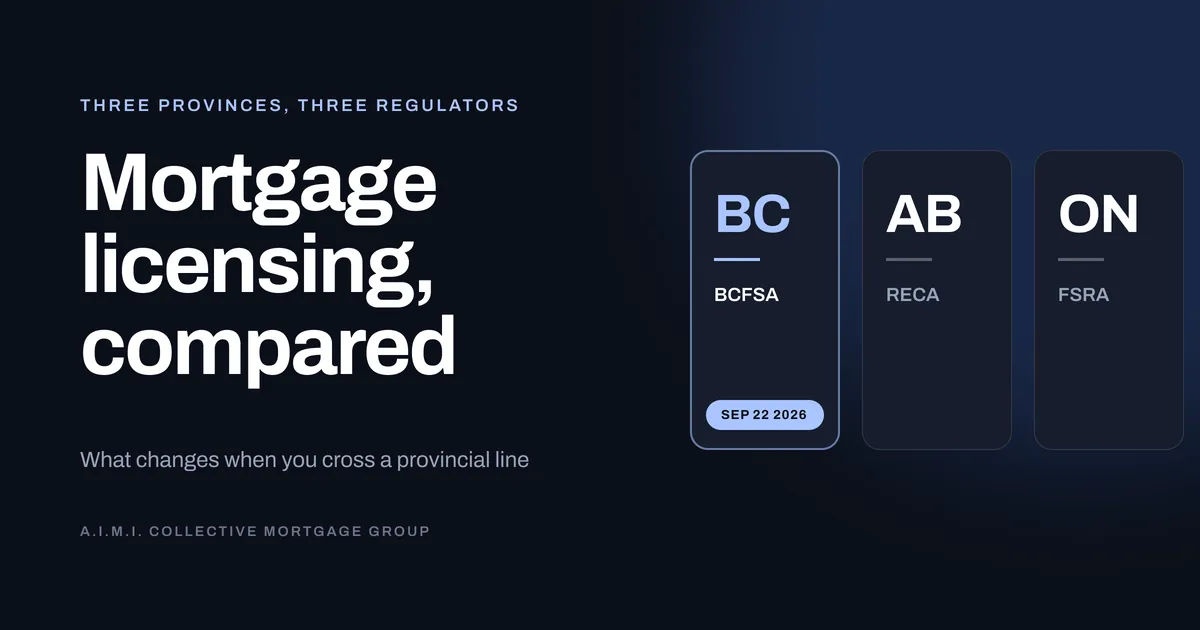
Mortgage licensing in Canada is provincial, and the three largest broker markets do not work the same way. If you are licensed in one province and thinking about another, or you simply want to understand how your own system compares, here is the honest picture.
One thing to get out of the way first: a licence in one province does not carry over to another. Each has its own regulator, its own education, and its own structure. Working in a second province means licensing there.
British Columbia, and the change coming this October
BC is regulated by BCFSA, and it is the only one of the three currently mid transition.
The Mortgage Services Act comes into force on October 13 2026, replacing the old Mortgage Brokers Act framework. It brings two licence levels, Principal Broker and Mortgage Broker, and separates what you are licensed to do into categories: dealing in mortgages, trading in mortgages, administering mortgages, and mortgage lending. The lending category arrives in a later phase.
The date BC brokers cannot miss
Every current registrant who intends to keep providing mortgage services after October 13 2026 must complete their required MSA transition education by September 22 2026.
BCFSA is unusually direct about the consequence. If you have not completed it by that date, your registration will not transition to a licence, you will not be able to provide mortgage services until you become licensed, and you may be subject to disciplinary action. Principal Brokers have more coursework to complete than everyone else.
Alberta
Alberta is regulated by RECA and uses a two class system that is refreshingly simple.
Mortgage associate is the entry licence. You need to be at least 18, have a high school diploma or equivalent, demonstrate English proficiency, complete the Mortgage Associates Program, provide a certified criminal record check, and be hired by a licensed brokerage as an employee or independent contractor. The programme is two courses: Fundamentals of Mortgage Brokerage, and Practice of Mortgage Brokerage.
Mortgage broker is the senior licence. It requires the Mortgage Brokers Program plus at least two years of licensed work experience within the last five years.
Note what Alberta does not do: there is no restriction on which lenders an associate can place business with. The tiering is about seniority, not about lender access.
Ontario
Ontario is regulated by FSRA, and its tiering works on a completely different principle. Here the levels control which lenders you may deal with.
Mortgage Agent Level 1 may deal and trade in mortgages with financial institutions as defined in the Mortgage Brokerages, Lenders and Administrators Act, and with lenders approved by CMHC under the National Housing Act. In practice that is banks, credit unions and CMHC approved lenders. Level 1 agents cannot place private mortgages at all, which rules out mortgage investment corporations, syndicates, private individuals, and other brokerages acting as lender.
Mortgage Agent Level 2 can deal with all of the above plus every other category of lender, including private. To upgrade you need to have held a Level 1 licence for at least 12 months within the last 24, complete an approved Private Mortgage Course within the two years before you apply, be sponsored by a licensed brokerage, and pass suitability verification. There is no additional licence fee if you are upgrading from an active Level 1 licence.
The difference that actually matters
Alberta and BC tier by seniority and responsibility. Ontario tiers by lender access.
That single distinction catches people. An Ontario agent on Level 1 can be experienced, well referred and busy, and still be unable to place a self employed client with strong equity and bruised credit. An Alberta associate in their first year faces no such wall. Brokers moving between the two provinces are often surprised by it in one direction or the other.
If you are thinking about a second province
Plan around the lead times rather than the paperwork. Ontario has a twelve month clock on the Level 1 to Level 2 upgrade. Alberta has a two year experience requirement before the broker licence. BC has a hard education deadline in September 2026 that has nothing to do with anything else on your calendar.
None of these can be arranged quickly when the right opportunity appears. They only start when you start them.
Where we come in
A.I.M.I. Collective Mortgage Group is licensed in all three provinces, with over 200 brokers across British Columbia, Alberta and Ontario. That means our compliance team handles all three regulators routinely rather than treating two of them as exceptions.
If you are licensed in one province and considering another, or you are already licensed in more than one and tired of explaining that to your brokerage, we are happy to talk it through.
Related reading
- Mortgage Agent Level 1 vs Level 2 in Ontario, a closer look at the Ontario tiers
- The September 22 2026 deadline every BC mortgage broker needs to know
- How to switch mortgage brokerages in BC, Alberta or Ontario
This article is general information, not legal or licensing advice, and requirements change. Confirm current rules directly with BCFSA, RECA or FSRA before making any licensing decisions.