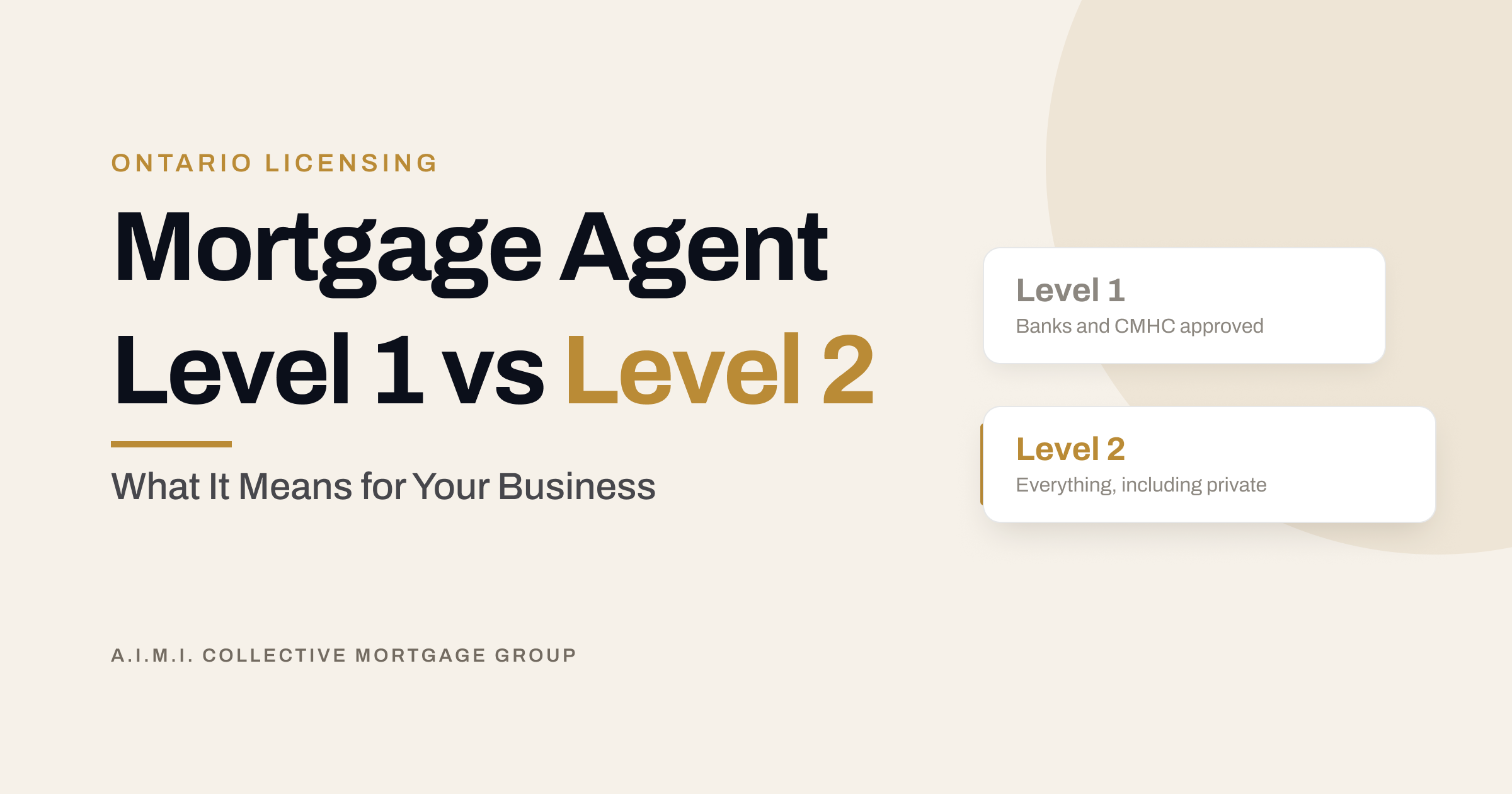
If you are licensed in Ontario, your licence level decides which deals you are allowed to take. A lot of agents discover the limit the hard way, when a file they have already worked turns out to be one they cannot legally place.
What a Level 1 agent can do
A Mortgage Agent Level 1 may deal and trade in mortgages with financial institutions as defined in the Mortgage Brokerages, Lenders and Administrators Act, and with lenders approved by CMHC under the National Housing Act.
In practice that means banks, credit unions, insurance companies and CMHC approved lenders. Everyday A lending.
What a Level 1 agent cannot do
Level 1 agents are restricted from private mortgages entirely. That includes:
- Mortgage investment corporations
- Syndicated mortgages
- Private individual lenders
- Other agents, brokers or brokerages acting as the lender
This is the line that catches people. A self employed client with strong equity and bruised credit is often a private deal, and a Level 1 agent cannot place it.
What Level 2 unlocks
A Mortgage Agent Level 2 can arrange mortgages with financial institutions, CMHC approved lenders under the National Housing Act, and every other category of lender, including mortgage investment corporations, syndicates, private individuals, agents, brokers and brokerages.
Level 2 is the licence that lets you serve the whole client base rather than the half that fits a bank.
How to move from Level 1 to Level 2
FSRA sets out the requirements clearly:
- Be 18 or older and a Canadian resident with an Ontario mailing address that is not a PO box
- Have held a Mortgage Agent Level 1 licence for at least 12 months within the last 24 months
- Complete an approved Private Mortgage Course within the two years before you apply
- Be sponsored by a licensed mortgage brokerage
- Pass FSRA suitability verification
There is no additional licence fee if you are upgrading from an active Level 1 licence. FSRA approved course providers include Mortgage Professionals Canada, the Canadian Mortgage Brokers Association Ontario, and REMIC.
Why this is a business decision, not just a compliance one
Every private or alternative file you cannot place is a client you either refer away or lose. Referring the deal keeps the relationship for now, but it teaches the client that someone else solves the harder problems. Over a few years that is a meaningful amount of repeat and referral business handed to another broker.
The twelve month waiting period also means this is not something you can arrange on demand when the right file lands. If you are on Level 1 today, the clock only starts when you decide to start it.
Where we come in
A.I.M.I. Collective Mortgage Group works with brokers across Ontario, Alberta and British Columbia. Our brokers submit directly to more than 100 lenders spanning A, B, private and alternative, and our Deal Desk provides underwriting support on the commercial, B and alternative files that are hardest to structure.
If you are weighing the move to Level 2, or you are already Level 2 and not using it because you have no alternative panel behind you, we are happy to talk it through.
Common questions
What does mortgage agent level 1 mean?
Level 1 is Ontario's entry licence. A level 1 agent can arrange mortgages only with financial institutions and lenders approved under the National Housing Act, working under a licensed brokerage.
What is mortgage agent level 2?
Level 2 adds private lenders, mortgage investment corporations and syndicated mortgages. It requires 12 months licensed within the last 24 and the FSRA approved Private Mortgage Course.
Can a mortgage agent be dual licensed?
Not within Ontario, since level 1 and level 2 are steps on one ladder. A dual licensed agent usually means someone holding licences in two provinces, for example Ontario and BC, which requires meeting each regulator's requirements separately.
Related reading
- Mortgage licensing in BC, Alberta and Ontario compared
- What is B lending, the deals a Level 2 licence unlocks
- How to switch mortgage brokerages in BC, Alberta or Ontario
This article is general information, not legal or licensing advice. Confirm current requirements directly with FSRA before making any licensing decisions.