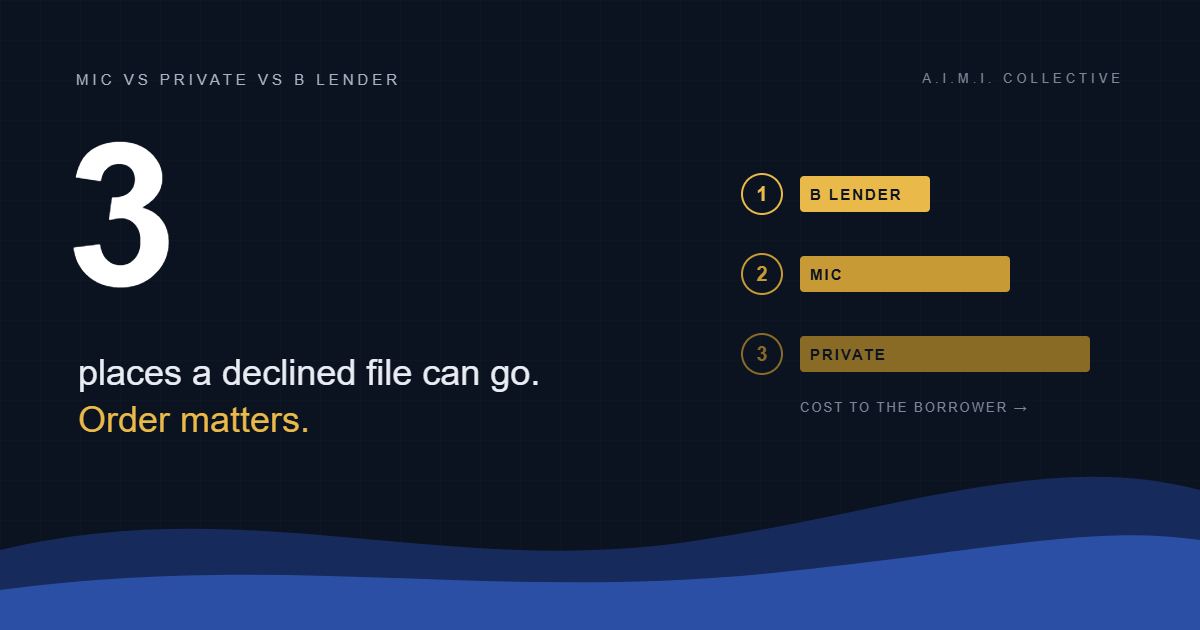
When a bank declines a file, most clients hear one word: private. In practice there are three very different places the deal can go, and choosing the wrong one costs your client thousands of dollars or costs you the deal. Here is how B lenders, mortgage investment corporations and private individual lenders compare, and the order we work through them.
B lenders
B lenders, also called alternative lenders, include trust companies and some credit unions. They lend on files that do not fit A lender rules: self employed income that is hard to prove, bruised credit, a recent consumer proposal, or debt ratios that are too high for a bank. They still verify income and credit, just more flexibly, and they offer real mortgage terms, usually one to three years.
Rates sit above A lender pricing but well below private money, and the broker commonly charges a fee of around 1 percent on top of a lower finder's fee. For a client who can qualify, a B lender is almost always the cheapest way through. Our guide to B lending in Canada covers who they lend to.
Mortgage investment corporations
A MIC is a company that pools money from investors and lends it on mortgages. What makes it a MIC is its tax status under section 130.1 of the Income Tax Act, which requires at least 20 shareholders, at least half its assets in residential mortgages, insured deposits and cash, and caps on real estate holdings and leverage. Our guide to mortgage investment corporations sets out the full conditions.
MICs lend on equity more than income. They move quickly, can take larger loans than most individuals and will lend on situations a B lender will not touch: no provable income, a mortgage that has been called, a construction or land deal, or a client who needs funds in days. The price reflects that. Atrium MIC, which trades on the TSX, reported a weighted average rate of 8.69 percent on its portfolio at the end of June 2026, with 96.9 percent first mortgages and an average loan to value of 62.5 percent. Firm Capital MIC reported 9.13 percent. Lender fees of 2 to 4 percent on first mortgages are common, and seconds cost more.
Private individual lenders
A private individual lends their own money, often through a broker or a mortgage administrator. They can be the most flexible option of all, on small seconds, unusual properties or short bridge loans that do not fit a MIC's book. They can also be the hardest to manage: terms vary widely, renewals are at the lender's discretion, and the paperwork and disclosure standards depend heavily on the broker arranging the deal.
How we choose
This is our own working order rather than a regulatory rule, and every file is different.
- Can it qualify with a B lender? If yes, that is where it goes. Lower rate, longer term, a clear path back to an A lender.
- Is it about speed, size or equity? If the client needs funds fast, needs more than an individual can lend, or has equity but no qualifying income, a MIC is usually the next step.
- Is it small, unusual or short? A small second mortgage, a property type a MIC will not finance, or a few months of bridge financing can fit a private individual best.
Whichever lender you use, the exit is part of the file. Private money is meant to be temporary. Before the client signs, write down how they get out: a sale, a refinance to a B lender once credit recovers, or a renovation that lifts the value. A private mortgage with no exit is a renewal at the lender's price.
What protects you and your client
Disclose every fee in writing, early. Broker fees and lender fees on private files must be disclosed before the client commits, in every province. Put the total cost of borrowing in front of them in plain numbers.
Know who you represent. In Alberta, RECA has proposed a rule that licensees represent the lender, never the borrower, in deals with private lenders. It is not in force yet, but it shows where regulators are heading. Our guide to Alberta licensing tracks the proposal.
Do not drift into raising money. Arranging a mortgage is mortgage brokering. Finding investors for a MIC or a pool is securities activity, governed by provincial securities regulators. A mortgage licence does not cover it.
Watch the lender, not just the deal. Romspen, once one of Canada's largest private mortgage funds, has had redemptions suspended since November 2022 and is winding down its book. In June 2025 the Capital Markets Tribunal found that Bridging Finance and three senior employees committed or took part in fraud. Those were investor losses, not borrower ones, but a lender under strain renews less generously. Place clients with lenders whose disclosures you can actually read.
Getting it right more often
Most brokers place a handful of private files a year, which makes it hard to know which lender takes what. That is where a team helps: a deal desk that has seen the file type before and a room of brokers who will tell you which MIC took a similar deal last month. At A.I.M.I. Collective our Deal Desk places the files that need a lender you have not worked with before.
Rates and figures are from public company disclosures and published sources as of October 2026. This is general information, not legal, tax or investment advice.