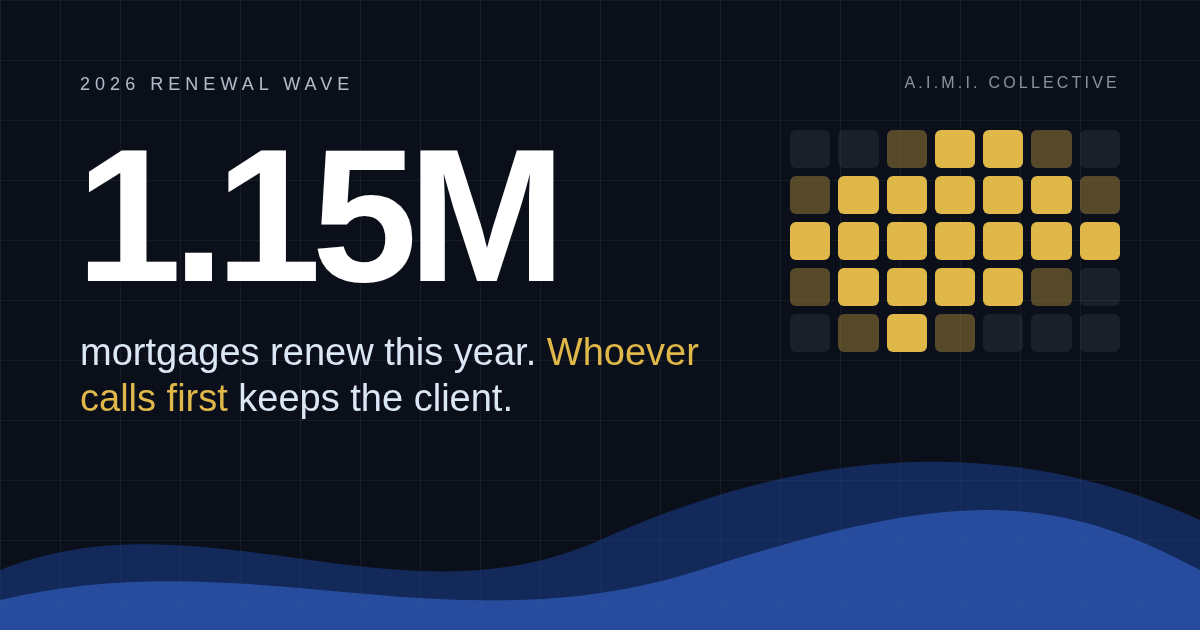
CMHC's 2026 Housing Market Outlook puts roughly 1.15 million mortgages up for renewal this year, and a Bank of Canada staff analysis estimates that about 60 percent of all outstanding Canadian mortgages renew across 2025 and 2026. A large share of those were written in 2020 and 2021 at rates under 2 percent. The same Bank of Canada note expects five year fixed borrowers renewing in 2026 to see payments rise by around 20 percent on average against what they paid at the end of 2024.
For a homeowner that is a shock. For a broker it is the largest, most predictable pipeline of the decade, and most brokers are letting the lender's renewal letter win it by default.
Why the banks win renewals
The lender sends a renewal offer 120 days out. The client signs it because nobody else called. That is the whole story. Bank retention rates on renewals are high not because the offer is good but because the alternative never showed up.
The 120 day rule
Every client in your database has a maturity date. Sort by it. Anyone maturing in the next 120 days gets a call this week, not an email, a call. The script is short: your renewal is coming, the rate environment has changed, let me price it against the market before you sign anything. That conversation is a funded file in most cases, and it costs nothing to originate.
Three outcomes, and you should be ready for all three
- Switch. The client qualifies and another lender is sharper. A straight switch or transfer, often with the new lender covering costs.
- Stay, with a better rate. Sometimes the incumbent matches once the client has a competing offer in hand. You still earned the trust and the next file.
- No longer qualifies at A. Income changed, debt grew, or the payment jump breaks the ratios. This is the file most brokers lose, and it is where B lending and private options keep the client in the house and keep them yours.
Where the brokerage comes in
Renewal season rewards speed and product range. Speed comes from lender status: a switch that funds in five days beats a bank offer expiring on Friday. Range comes from having B, private and alternative lenders on the panel and an underwriter who can structure the file that no longer fits at A. At A.I.M.I. Collective every broker submits under top tier status and can send the hard renewals to the Deal Desk.
The database is the cheapest lever in the business. Our guide on scaling from $10 million to $50 million puts it first for a reason. 2026 is the year it pays.