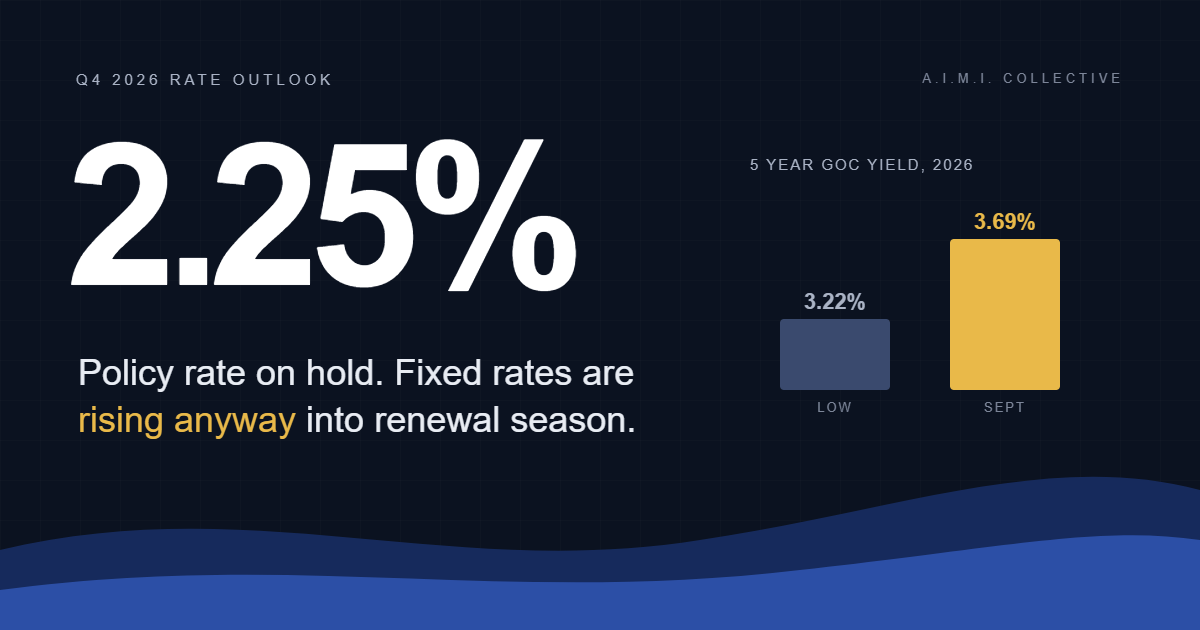
The Bank of Canada has not moved since October 2025. Its policy rate sits at 2.25 percent after a sixth straight hold on 2 September, and prime at the big banks is 4.45 percent. If you only watched the overnight rate, you would think nothing happened this fall. Your fixed rate clients know better.
The five year Government of Canada bond yield, which drives fixed mortgage pricing, went from 3.22 percent on 25 August to 3.69 percent by the last week of September. Lenders followed. Ratehub reported that the fixed rates under 4 percent still available in early September had disappeared within two weeks. As of 1 October the best insured five year fixed in the market was 4.34 percent, and the big bank posted specials ran from 4.59 to 4.99 percent.
Where rates sit going into Q4
- Policy rate: 2.25 percent, unchanged since 30 October 2025.
- Prime: 4.45 percent.
- Best five year variable: about 3.40 percent, or prime minus 1.05, on insured files. Uninsured variable is closer to prime minus 0.60.
- Best five year fixed: about 4.34 percent insured, and around 5.09 percent on uninsured files at one major online lender.
- Inflation: 3.0 percent in August, held up by gasoline. The Bank's preferred core measures were much calmer, at 1.9 and 2.0 percent.
That gap between headline and core inflation is the whole story of this fall. Bond markets are pricing the possibility that inflation stays sticky, while the Bank itself has said it is prepared to adjust policy as needed and has not signalled a move either way.
The two dates that matter
The Bank has two announcements left this year: Wednesday 28 October, which comes with a full Monetary Policy Report, and Wednesday 9 December. Both land at 9:45 in the morning Eastern.
The consensus is a hold. In the August round of big bank forecasts, all six expected the policy rate to finish 2026 at 2.25 percent. After the September decision, economists at BMO, CIBC, RBC and TD all said much the same thing. The outlier was Capital Economics, which called a December hike more likely than it had been. Looking into 2027, the big banks split: TD and BMO see no change, National and CIBC see 2.75 percent, Scotiabank 3.00 and RBC 3.25 percent by the end of next year.
So the realistic range for your clients is flat to higher, not lower. That changes the conversation you should be having.
Who is renewing, and how hard it lands
CMHC data reported last year put renewals at more than a million mortgages in 2026 and about 940,000 in 2027. The worst of the payment shock is behind the market: CMHC said in May that renewal volume this year would come in about 13 percent below 2025.
The cohort still to come is the one that hurts. The Bank of Canada's 2026 Financial Stability Report says about 12 percent of outstanding mortgages are the last pandemic era fixed loans, renewing in 2026 and 2027 with payment increases of roughly 15 percent. It also estimates that about 4 percent of borrowers nationally, and about 9 percent in the Toronto area, could be unable to refinance in 2027 at today's home prices. Arrears are still low, at 0.24 percent nationally at the end of 2025, but Toronto arrears were up 45 percent year over year.
What to do with your book this quarter
Start the 2027 renewals now. Anyone renewing in the first half of 2027 is inside the window where most lenders will hold a rate for 120 days. With fixed rates climbing, a hold placed in October protects the client if yields keep rising and costs nothing if they fall. Pull your maturity list today and book the calls.
Have the fixed or variable conversation properly. Variable has been winning: 42 percent of new bank mortgages were variable by February, against 11 percent for five year fixed. With prime minus 1.05 available and a forecast range that is flat to higher, the spread between a 3.40 variable and a 4.34 fixed is about 94 basis points. That buys a lot of room before a variable client is worse off. Walk clients through the numbers rather than the headlines, and document the advice.
Use the straight switch. Since 21 November 2024, a client switching lenders at renewal with the same loan amount and amortization does not have to pass the stress test, insured or uninsured. A client who would fail qualification today can still leave their bank for a better rate. Most of your competitors at the branch will not mention it.
Find the refinance problems early. The clients the Bank is worried about are the ones who need more money, not just a new rate. Anyone who needs to consolidate debt or pull equity and is close to the edge should hear from you now, while you still have time to place them with a B lender or a private lender and build an exit plan. Our guide to mortgage investment corporations and our post on choosing between a MIC, a private lender and a B lender cover where those files go.
Remember the rules that did change. The insured price cap is 1.5 million dollars, and 30 year amortization is open to every first time buyer and every buyer of a new build. OSFI confirmed in January that the stress test stays as it is, and its loan to income limits on lenders exclude renewals and refinances.
The opportunity
A flat policy rate with rising fixed rates is the market where advice is worth the most. A client renewing with the bank by mail will take whatever the letter says. A client who hears from their broker 120 days out gets a rate hold, a real comparison and a switch that does not need a stress test. That is the difference between a book that renews with you and one that quietly leaves.
If you want a deeper plan for the renewal wave, read our 2026 renewal playbook and the guide on losing renewals to the bank.
Rates and forecasts are as published at the start of October 2026 and change quickly. This is general information, not financial advice for any individual client.